
PRODUCTION AND DEVELOPMENT
EREENIE OIL AND GAS FIELD
agellan holds a 35% interest in the Mereenie oil and gas field (Petroleum Leases PL4 & PL5) located approximately 250 kilometres west of Alice Springs in the Amadeus Basin of the Northern Territory. The Mereenie field is the major source of the Company’s oil and gas sales revenues, contributing $16.7 million during the 2003-2004 year.
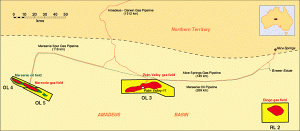
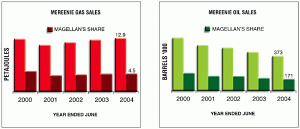
Gas SalesThe Mereenie field is the Northern Territory’s leading gas producer with increased gas sales in 20032004 of 12.9 PJ (11.0 Bcf) compared to 12.6 PJ (10.8 Bcf) last year. The Company’s share of gas sales increased by 2% to 4.5 PJ (3.9 Bcf) or 12.3 TJ (10.6 MMcf) per day. Company gas sales revenue was up 3% to $11.0 million, as a result of the increased sales volumes and marginally higher average gas prices.
Gas MarketingThe Mereenie field continued to meet contracted supplies to Gasgo Pty Limited, the principal gas purchaser. The bulk of the gas is used by the Northern Territory’s Power and Water Corporation for electricity generation, principally in Darwin. The total amount of Mereenie gas contracted to Gasgo is more than 180 PJ, of which approximately 71 PJ remains to be delivered over the remaining contract periods to June 2009.
Oil SalesThe Company’s annual oil sales from Mereenie were 10% lower than last year, reflecting the continued natural oil production decline from the field. Oil sales totalled 131,000 barrels (360 barrels per day) compared to 145,000 barrels last year. The field currently is producing at a rate of around 1,100 barrels of oil per day.
The Company’s revenue from crude oil sales decreased by 9% from $6.2 million to $5.7 million. The decline in sales was offset in part by higher prevailing world crude oil prices throughout the current period.
Oil MarketingCrude oil and stabilised condensate produced from the field is transported through the joint venture’s 269 kilometre pipeline to Brewer Estate, south of Alice Springs. It is then trucked to Port Bonython in South Australia where it is sold to the South Australian Cooper Basin producers. The Mereenie joint venturers funded a truck off-loading facility at Port Bonython to allow the crude to be exported through that facility when the Mobil Port Stanvac refinery closed in mid 2003.
OperationsAn upgrade in capacity of 13 kilometres of gas pipeline joining the wells on the western end of the field with the Mereenie central treatment plant was completed in 2003.
This was followed by a major upgrade of the gas compression facilities at the central treatment plant, which was commissioned this year. In total a further 2600 HP of compression has been added to the field which will enable increased deliverability of gas to meet the contracted gas quantities over the remaining contract periods to June 2009.
The existing gas sales contracts require progressively increasing volumes of sales gas over that period. The field will reach a peak gas delivery capacity in 2008 with the drilling of additional gas wells on the field to tap the current un-developed proved and probable gas reserves.
The joint venture will drill two gas development wells later this year. The wells, East Mereenie-43 and West Mereenie-18, will target gas reserves in the Pacoota P1 gas cap, and will increase gas deliverability from the field to meet the contracted gas quantities over the next several years. Both wells will be drilled with air/foam and completed without placing drilling mud in the well to prevent damage to the reservoir, thereby maximising gas deliverability from the wells.
Oil and Gas ReservesBased on reserve estimates carried out as at the end of 2003 by the Mereenie operator, Santos Ltd, remaining recoverable oil (including condensate) and gas reserves for the Mereenie field as at 30 June 2004, are estimated as follows:
Oil and Gas ReservesBased on reserve estimates carried out as at the end of 2003 by the Mereenie operator, Santos Ltd, remaining recoverable oil (including condensate) and gas reserves for the Mereenie field as at 30 June 2004, are estimated as follows:
Remaining Recoverable Oil Reserves:
| Proved Reserves |
3.4 MMSTB
|
|
Proved & Probable Reserves |
6.0 MMSTB |
| Proved, Probable & Possible Reserves |
8.6 MMSTB
|
Remaining Recoverable Gas Reserves:
| Proved Reserves |
94 Bcf
|
|
Proved & Probable Reserves |
175 Bcf |
| Proved, Probable & Possbile Reserves |
334 Bcf
|
Cumulative production reported by Santos from the Mereenie field to 30 June 2004, totalled 14.5 million barrels of oil and 151 Bcf of gas.
PALM VALLEY GAS FIELD
The company holds a 52.023% interest in the Palm Valley gas field (Petroleum Lease PL3) in the Amadeus Basin, located approximately 120 kilometres west of Alice Springs in the Northern Territory. The Magellan-operated gas field has been in production since 1983, and provides gas for electricity generation in the Northern Territory, mainly in Alice Springs and Darwin.
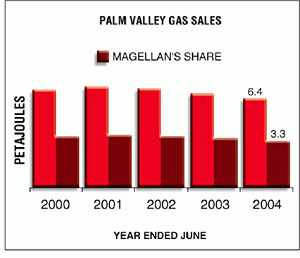
Gas production from the field totalled 157 Mm3 (5.6 Bcf) during the 20032004 year, a 7% decline from the previous year. Gas deliverability is being maintained by the use of compression to counteract the natural production decline of the gas reservoir. The field currently is producing at the rate of approximately 0.42 Mm3 (14.8 MMcf) of gas per day.
Gas SalesDuring the 20032004 year, gas sales decreased 4% from 6.7 PJ (5.9 Bcf) to 6.4 PJ (5.5 Bcf), with the Company’s share being 3.3 PJ (2.9 Bcf) or 9.1 TJ (7.8 MMcf) per day. The Company’s revenue declined 13% from $7.5 million to $6.4 million.
In addition to the reduction in sales from the field, the gas purchaser reduced its demand under the higher-priced Alice Springs Gas Sales Agreement from July 2003.
 OperationsUnder the Palm Valley Gas Purchase Agreement, the producers are obliged to maximise production from the field through to the end of the contract period in January 2012 while operating in accordance with good oil field practice.
Field compression continues to operate efficiently, but is currently nearing the limit of its 2600 HP capacity. A further 600 HP of field compression will be installed in 2005.
Magellan drilled the Palm Valley-11 development well during June-August this year. The well was located on the south-western end of the field and was deviated to the south through the productive Stairway and Pacoota Sandstones. The well was drilled using airfoam to minimise damage to the natural rock fractures from which the gas is produced. No reservoir-effective fractures capable of commercial gas flows were encountered in the well.
The Company has in place Government approved Health, Safety and Environmental management plans to monitor and improve the safety of the gas plant and work practices, as well as to assist with environmental and cultural heritage issues at the field which is located on Aboriginal Land, adjacent to the Finke Gorge National Park.
Petroleum Lease PL3 which was granted in November 1982 was renewed by the Northern Territory Government for a further term of 21 years. As the lease lies within the Haasts Bluff Aboriginal Land Trust area, a new agreement was reached with the Central Land Council and the traditional Aboriginal owners on future operations on the lease.
Gas ReservesBased on a 1999 independent expert reserves and deliverability study, estimated total remaining recoverable reserves for the Palm Valley gas field as at 30 June 2004 are as follows:
Remaining Recoverable Gas Reserves:
| Proved Reserves |
92 Bcf
|
|
Proved & Probable Reserves |
95 Bcf |
| Proved, Probable & Possbile Reserves |
612 Bcf
|
Cumulative gas production to 30 June 2004 is 134 Bcf.
Palm Valley reserve estimates are based on simulation modelling of the field. It is unlikely that the large possible reserves will be developed in the foreseeable future using current technology.
NOCKATUNGA OIL FIELDS
Magellan acquired a 40.936% interest in Petroleum Leases 33, 50 and 51 and the surrounding exploration permit ATP 267P from Voyager Energy, effective 1 July 2003. The PLs cover eight small oil fields in the Nockatunga area in the Cooper Basin of southwest Queensland. The fields which include the Dilkera, Koora, Maxwell, Maxwell South, Muthero, Nockatunga, Thungo and Winna oil fields, were discovered during the 19801990s and are operated by Santos Ltd.
Oil SalesThe Company’s oil sales from the Nockatunga fields for 20032004 totalled 40,000 barrels (110 barrels per day). The Company’s revenue from crude oil sales totalled $1,554,000. Crude oil produced from each of the fields is trucked and sold to the IOR Energy oil refinery at Eromanga in southwest Queensland.
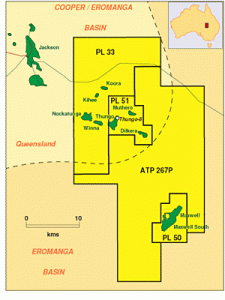 OperationsTotal production from the 19 producing wells on the fields currently is approximately 285 BOPD. Production is mainly from the Murta Formation reservoir, and production from each of the fields is declining naturally. Thungo and Maxwell are the two principal producing fields, and both have further development potential.
A development well, Thungo-8, was drilled on the Thungo field in November 2003. After fracture stimulation the well was completed as a Murta oil producer, and came on-line in March 2004, but at a lower oil rate than a normal Murta Formation well.
Further drilling will be required to develop probable and possible oil reserves, which occur principally in the Maxwell and Thungo fields. The joint venture is undertaking a 247 km2 3D seismic survey over the northern group of fields in the third quarter of 2004, as well as parts of the adjacent ATP 267P, to more closely define delineation and near field exploration well locations for drilling in 2005.
ReservesBased on reserve estimates carried out as at the end of 2003 by the operator, Santos Ltd, total remaining recoverable oil reserves for the Nockatunga fields as at 30 June 2004, are estimated as follows:
Remaining Recoverable Oil Reserves:
| Proved Reserves |
0.6 MMSTB
|
|
Proved & Probable Reserves |
1.4 MMSTB |
| Proved, Probable & Possbile Reserves |
3.9 MMSTB
|
Cumulative production from the Nockatunga fields to 30 June 2004, totalled 3.7 million barrels of oil.
DINGO GAS FIELD
Magellan has a 34.3365% interest in the Dingo gas field, located approximately 60 kilometres south of Alice Springs in the Northern Territory. Discovered in the 1980s, the field is held under Retention Licence RL2. A market is yet to emerge to allow the economic development of the 20 PJ Dingo gas resource. The two existing wells, Dingo-2 and 3, are capable of delivering around 1 PJ of gas per annum should a suitable gas marketing opportunity arise.